
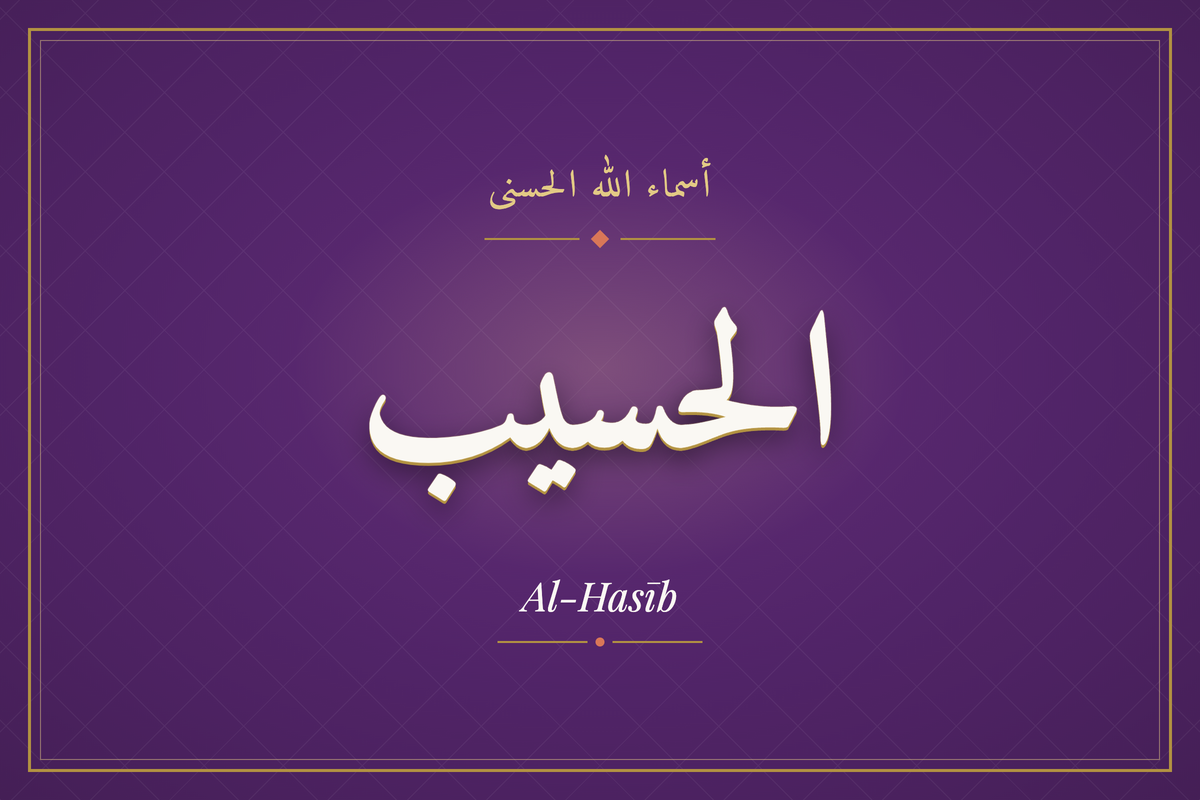
Al-Hasīb (الحَسِيب), "The One who suffices" and "The One who calls to account", is a Name of Allah with two aspects — and both bring peace to the believer. On one hand, Allah suffices for whoever relies upon Him: Hasbunā Allāh. On the other hand, it is He who will settle all accounts: no good deed will be overlooked, no injustice forgotten. The believer can therefore move forward with ease: his Guarantor is also his Judge.
What does Al-Hasīb mean?
The name Al-Hasīb comes from the Arabic root hā'-sīn-bā' (ح س ب), which carries two twin meanings: to count (hisāb) and to suffice (hasb). Applied to Allah, this Name designates:
- The One who suffices: He suffices as support, as protector and as witness to whoever places their trust in Him.
- The One who keeps account: every deed, every word, every intention is recorded with a precision that no accountant can imagine.
- The One who will settle the accounts: on the Day of Resurrection, He will reward each one with perfect justice — and with a swiftness that the Quran emphasizes: "Allah is swift in His reckoning."
Al-Hasīb in the Quran
Allah says:
إِنَّ اللَّهَ كَانَ عَلَىٰ كُلِّ شَيْءٍ حَسِيبًا
« Allah takes account of all things. » (Surah An-Nisā', 4:86)
And when the Companions were informed that their enemies had gathered their forces against them, their response was:
حَسْبُنَا اللَّهُ وَنِعْمَ الْوَكِيلُ
« Allah is sufficient for us, and what an excellent Guardian! » (Surah Āl 'Imrān, 3:173)
Allah also promises: « Whoever places his trust in Allah, He suffices him » (Surah At-Talāq, 65:3). Divine sufficiency is not a slogan: it is a Quranic promise addressed to those who truly rely upon Him.

Living with Al-Hasīb daily
1. Say "Hasbiya Allāh" in difficulty
Faced with an injustice you cannot repair, a future you cannot control, a burden too heavy to bear: entrust the matter to the One who suffices. These were the words of Ibrāhīm cast into the fire and those of the believers threatened — and the outcome, each time, was beautiful.
2. Practice muhāsaba
Since the account will be settled, the believer gets ahead: a regular moment to examine one's days, to rejoice in the good, to repent of the rest. It is reported from 'Umar ibn al-Khattāb the famous saying: "Call yourselves to account before you are called to account."
3. Work for the register that remains
Men quickly forget the services rendered; Al-Hasīb forgets nothing. Do good even without witness or thanks: it is inscribed there where nothing is lost, and it is that register which will be read.
Invocation with the name Al-Hasīb
The Quran teaches the invocation of sufficiency: حَسْبِيَ اللَّهُ لَا إِلَٰهَ إِلَّا هُوَ ۖ عَلَيْهِ تَوَكَّلْتُ وَهُوَ رَبُّ الْعَرْشِ الْعَظِيمِ
"Allah suffices me. There is no deity except Him. In Him I place my trust, and He is the Lord of the Mighty Throne." (Surah At-Tawba, 9:129) — to be recited with a present heart whenever human means show their limitations.

Frequently Asked Questions about Al-Hasīb
What is the difference between Al-Hasīb and Al-Muhsī?
Al-Muhsī is He who counts all things, whose knowledge encompasses every detail. Al-Hasīb adds two dimensions: sufficiency (He suffices for His servants) and reckoning (He settles accounts). Counting is the knowledge; the hisāb is its just application.
When should one say "Hasbunā Allāhu wa ni'ma-l-Wakīl"?
In fear, threat, injustice suffered, or anything that exceeds our strength — as exemplified by the Companions in 3:173. It is a word of trusting surrender, not passivity: we act according to our means, and entrust the rest to the Guarantor.
Should the reckoning of the Last Day frighten the believer?
It should make him vigilant, not despairing. He who judges himself in this life, repents and does good will find his reckoning lightened — and Allah, in His grace, will cover His believing servant during the settling of accounts, as taught by the hadith of the intimate conversation (Al-Bukhārī and Muslim).
📚 Continue reading the 99 Names
−5% off our entire library with code BLOG5
Valid across the entire site, no minimum purchase — our thanks to our blog readers.
Discover our books on the Names of Allah


