
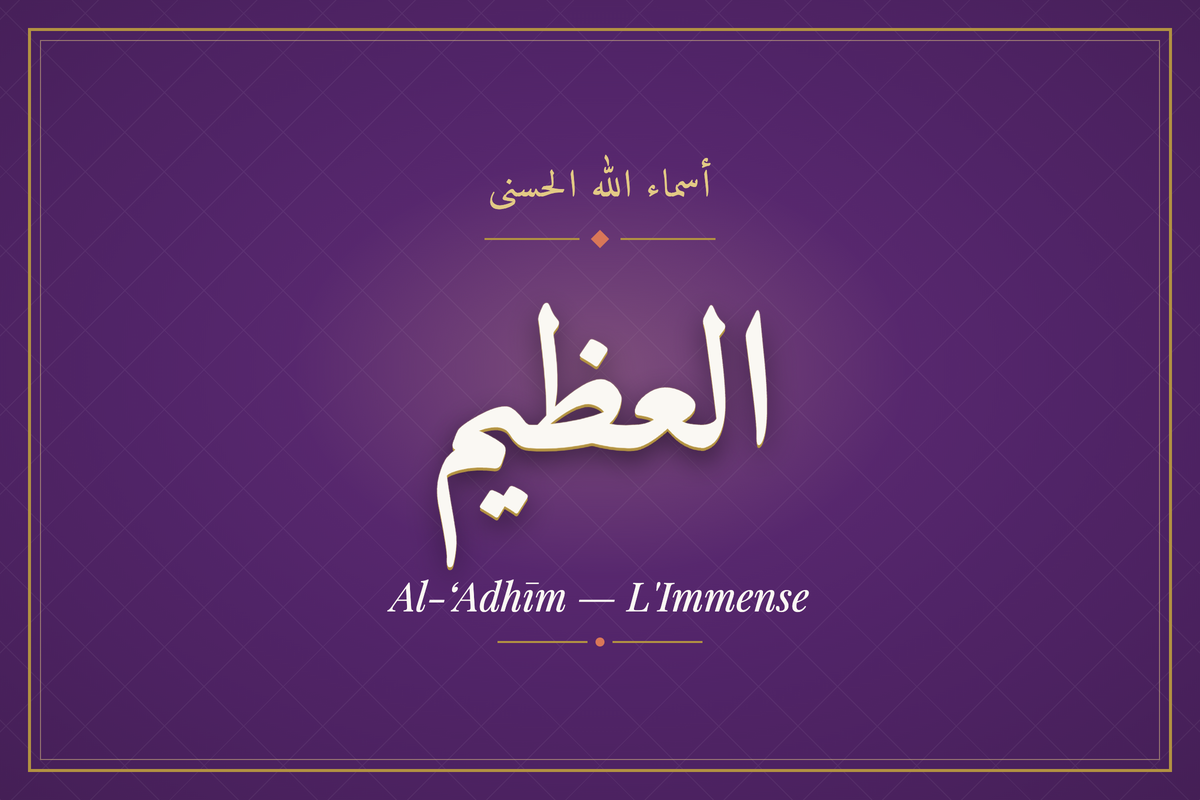
Al-'Adhīm (العَظِيم), "The Immense," "The Majestic," is the Name of Allah that expresses His absolute greatness: a greatness of essence, attributes, and sovereignty before which every creature—mountain, ocean, galaxy—is but an infinitesimal point. It is by this Name that the believer glorifies his Lord each day, bowed in his inclination: Subhāna Rabbiya al-'Adhīm.
What does Al-'Adhīm mean?
The name Al-'Adhīm comes from the Arabic root 'ayn-dhā'-mīm (ع ظ م), which expresses greatness, vastness, and majesty. Applied to Allah, this Name designates:
- The immensity of essence: Allah is greater than anything imagination can conceive; "His Footstool (Kursī) encompasses the heavens and the earth" (2:255).
- The perfection of attributes: His knowledge, His power, His mercy are without limit or flaw — a greatness of qualities, not merely of dimension.
- The majesty that calls for veneration: before Al-'Adhīm, hearts bow down; He alone deserves that one submit entirely before Him.
Al-'Adhīm in the Qur'an
It is by this Name that the greatest verse of the Qur'an concludes, Āyat al-Kursī:
وَلَا يَئُودُهُ حِفْظُهُمَا ۚ وَهُوَ الْعَلِيُّ الْعَظِيمُ
"Their preservation [of the heavens and the earth] does not tire Him. And He is the Most High, the Immense." (Surah Al-Baqara, 2:255)
Allah also commands:
فَسَبِّحْ بِاسْمِ رَبِّكَ الْعَظِيمِ
"So glorify the name of your Lord, the Immense." (Surah Al-Wāqi'a, 56:96)
When this verse was revealed, the Prophet ﷺ said: "Place it in your bowing (rukū')." (reported by Abū Dāwūd) This is the origin of the tasbīh that every Muslim recites while bowing in prayer.
Two Words Light on the Tongue, Heavy on the Scale
The Prophet ﷺ said: "Two words that are light on the tongue, heavy on the scale, beloved by the Most Merciful: Subhān Allāh wa bi-hamdihi, Subhān Allāh al-'Adhīm — Glory and praise be to Allah, glory be to Allah the Mighty." (Al-Bukhārī and Muslim)
Glorifying Al-'Adhīm requires only a moment, yet weighs more than all else: for it is to acknowledge, in two words, that all greatness belongs to Allah alone.

Living with Al-'Adhīm in Daily Life
1. Put Worries in Their Right Perspective
Whoever measures the greatness of Allah sees everything else shrink: financial problems, conflict, fear of tomorrow. Nothing is "too big" for the One whose guarding of the heavens and the earth does not weary Him.
2. Perfect Your Inclination in Prayer
The rukū' is the moment dedicated to this Name. Take time to pronounce Subhāna Rabbiya al-'Adhīm with consciousness: your body bowed, your heart acknowledging the Immensity — this is where prayer takes on its depth.
3. Refuse to Elevate Yourself
Meditating on Al-'Adhīm heals from pride: what place remains for human vanity before the Immense? The believer who knows this Name becomes great through humility, never through contempt for others.
Invocation with the Name Al-'Adhīm
Besides the tasbīh of the bowing, the Prophet ﷺ would supplicate in times of distress: « Lā ilāha illa-Llāhu al-'Adhīm al-Halīm… » — "There is no deity worthy of worship except Allah, the Mighty, the Most Forbearing" (Al-Bukhārī and Muslim). One may also ask: « Yā 'Adhīm, ighfir lī dhanbī al-'adhīm » — "O Mighty, forgive me my mighty sin", for none but the Mighty pardons what is mighty.

Frequently Asked Questions about Al-'Adhīm
What is the difference between Al-'Adhīm and Al-Kabīr?
Both Names express divine greatness. Al-Kabīr affirms that Allah is greater than all (this is the meaning of takbīr, Allāhu Akbar); Al-'Adhīm adds the nuance of immensity and majesty that fills hearts with veneration. The Quran employs them both, often alongside Al-'Alī (the Most High).
Why do we say "Subhāna Rabbiya al-'Adhīm" during bowing?
On the instruction of the Prophet ﷺ following the revelation of the verse "Glorify the name of your Lord, the Immense" (56:96). Bowing is a posture of humility: in it we proclaim the greatness of the One before whom we bow.
Where is Al-'Adhīm found in the Quran?
Notably at the end of Āyat al-Kursī (2:255), "And He is the Most High, the Immense," as well as in the glorification command of the surahs Al-Wāqi'a (56:74, 56:96) and Al-Hāqqa. Allah's Throne itself is qualified as immense in it: "Lord of the Immense Throne" (9:129).
📚 Continue reading the 99 Names
−5% off the entire library with code BLOG5
Valid on the entire site, no minimum purchase required — our thanks to blog readers.
Discover our books on the Names of Allah


